

When AI assistants get to *read the archive*.
For the first time in history a researcher can ask an old archive a natural question, in their own language, and get a written answer back. It doesn’t have to be a search query in disguise — it can be a sentence. “What did the council decide about the irrigation channel between 1780 and 1800?” “Where did the cholera outbreak of 1854 reach in this region?” “Trace the Bosch family across this corpus.”
The assistant connected to archAIc can answer all of these. What it cannot do — and this is the whole point — is make anything up.
The rule
Section titled “The rule”No source, no claim.
Every fact in the assistant’s answer must cite a specific page and a specific line in the archive. The system enforces this when it writes facts to the database; it filters anything unsourced when it reads them back. The assistant can produce a beautifully written paragraph about Don Emilio Romay, but it cannot say anything about Don Emilio Romay that doesn’t trace to a line of ink the user can read for themselves.
The effect on a research conversation is striking. Every claim the assistant makes is clickable. Click it; the page opens at the line where the evidence lives. Click another; another page opens. The assistant becomes less of an oracle and more of a guided tour, with a confident curator pointing at primary sources and saying here, and here, and here.
What the assistant can actually do
Section titled “What the assistant can actually do”It can search, in any of the four search shapes the system offers — by keyword, by meaning, by document type, by collection. It can browse: open any volume, list its documents, open any document, read its summary, list the people named in it. It can extract: pull every event from a document with its date, location and participants. It can roll up: take a single book and tell you how many distinct people are named across all of its documents. It can trace: follow a name across collections and produce a chronology of where they appear.
It can also flag honesty. If something is still in pending review — extracted but not yet confirmed by the curator — the assistant says so explicitly. “Five confirmed mentions and three pending review” is the kind of qualifier that does more for trust than any number of stylistic flourishes.
An example
Section titled “An example”A researcher asks: “Was there a Bosch family active in this corpus, and what were they known for?”
The assistant, without any custom code, will:
- Search the corpus for the surname Bosch
- For each hit, find out which document the matching page is part of
- Open each of those documents, find the relevant person entries, and read their roles and the events they’re attached to
- Aggregate the findings into a chronological sketch, with every name, role, and date carrying a citation to the page and line that supports it
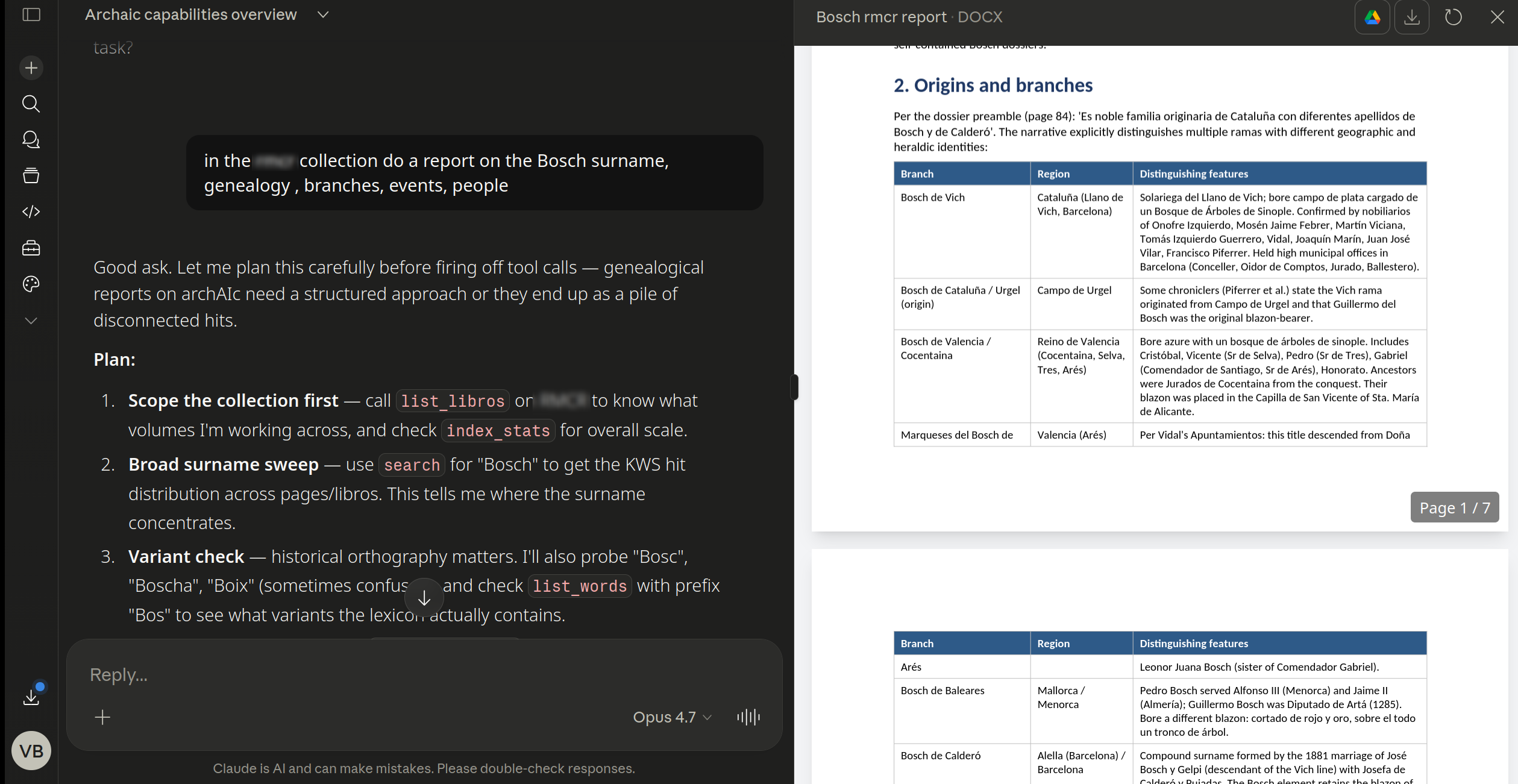 An assistant asked for a report on a surname. The response is a chronology; every sentence carries a citation; every citation opens the corresponding page at the right line.
Where the assistant has been given a fact it cannot source, it has two choices: either drop the fact entirely, or carry it forward and label it as a hypothesis. Both are honest. Neither is “make something up”.
What it doesn’t do
Section titled “What it doesn’t do”It doesn’t trigger expensive operations without permission. Re-running automatic boundary detection on a libro, or re-extracting metadata for a document, are jobs that cost compute and that an expert is going to want to review afterwards. The assistant always asks first. The curator always confirms.
It doesn’t override the expert’s review state. A document the curator hasn’t reviewed isn’t ground truth, and the assistant says so when it cites from it. A document the curator has rejected stays in the audit trail but never appears in a response.
It doesn’t bypass the citation rule. There is no debug mode, no admin override, no internal channel where the assistant gets to make claims without sources. The rule is a property of the database, not a policy of the assistant.
A trust contract, written down
Section titled “A trust contract, written down”This is the contract: the archive proposes, the expert decides, the assistant cites. The user can verify any claim in seconds. The institution gets an audit trail of every conversation an assistant ever had with their archive — every question asked, every page consulted, every answer produced. None of it is hidden. None of it is unsourced. None of it requires the user to take the system’s word for anything.
This is what we mean by an agent-ready archive. Not that we’ve trained an AI on the documents. That we’ve built the infrastructure that lets any modern AI assistant work the documents like a careful researcher would — under the supervision of, and bounded by, the expert who actually knows what the archive says.